|
| |
Past
Work: Impurity
Effects
|
| Transition-metal impurities degrade the minority charge-carrier lifetime in silicon. But the severity of the degradation can vary
considerably from one impurity to another, and also is modified in some cases by pairing
with other impurities, such as the commonly used dopants. We have
grown a number of controlled samples with various Fe impurity
concentrations. The table below shows
that the severity of lifetime degradation is greater when both Fe and Ga are present than
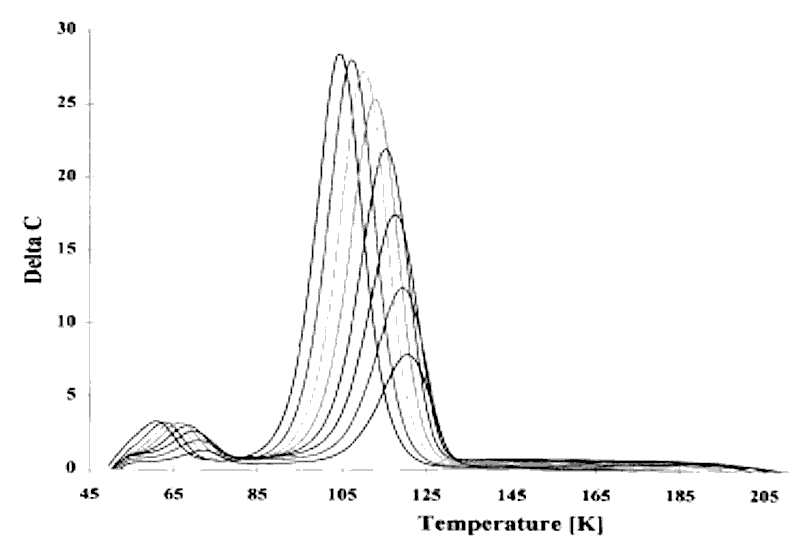
when either one exists alone in the Si crystal. The center figure shows deep-level
transient spectroscopy on one of these samples (done in collaboration with Georgia
Institute of Technology), from which we are able to obtain information about capture cross
sections and trap levels1.
Additional impurity studies have
included hydrogen, nitrogen,
oxygen, and carbon as well as the dopants boron, gallium, indium, and
aluminum. A new solid-source doping method for B in FZ grown silicon
crystals (bottom right) was reported at the 15th American Conf. on Crystal Growth and Epitaxy (ACCGE-15), July 20-24, 2003 and published in J. Crystal
Growth2.
| Crystal |
Resistivity
( Ω-cm) |
Ga
(cm-3) |
Fe
Target
(cm-3) |
Lifetime
(µs) |
| 41121 a |
3.5 |
3.8
x 1015 |
0 |
>
1400 |
| 51129-1 |
24,000 |
0 |
1.2
x 1014 |
12 |
| 70515 |
6 |
2.2
x 1015 |
4.8
x 1011 |
2.2 |
| 51212-1a |
4.1 |
3.3
x 1015 |
1.3
x 1014 |
0.40 |
| 51212-1b |
1.4 |
1 x
1016 |
1.3
x 1014 |
0.34 |
|
 |
 |
|
_________________
1T.F.
Ciszek, T.H. Wang, W.A. Doolittle, and A. Rohatgi, “Minority-Carrier Lifetime
Degradation in Silicon Co-Doped with Iron and Gallium,” in: 26th IEEE
Photovoltaic Specialist Conf. Record, Anaheim, CA, Sept. 29-Oct. 3, 1997 (IEEE,
New Jersey, 1997) pp. 59-62.
2T.F. Ciszek,
“Solid-Source Boron Doping of Float-Zoned Silicon,” J. of Crystal Growth 264
(2004) pp. 116-122.
|

